
In today’s complex financial environment, maintaining accuracy, control, and visibility across financial records is essential for effective decision-making and regulatory compliance.
As transaction volumes increase and financial operations become more interconnected, reconciliation processes often become time-consuming and prone to inconsistencies when managed manually. Delays in reconciliation can directly impact financial reporting, audit readiness, and overall operational efficiency.
This is where Account Reconciliation Services play a critical role.
According to industry data, businesses that implement structured reconciliation processes and automation can reduce financial discrepancies by up to 80% and improve reporting accuracy significantly. Additionally, companies adopting account reconciliation outsourcing achieve faster close cycles and better operational efficiency.
What Are Account Reconciliation Services?
Account Reconciliation Services involve comparing financial records from different sources to ensure consistency and accuracy.
These services typically include:
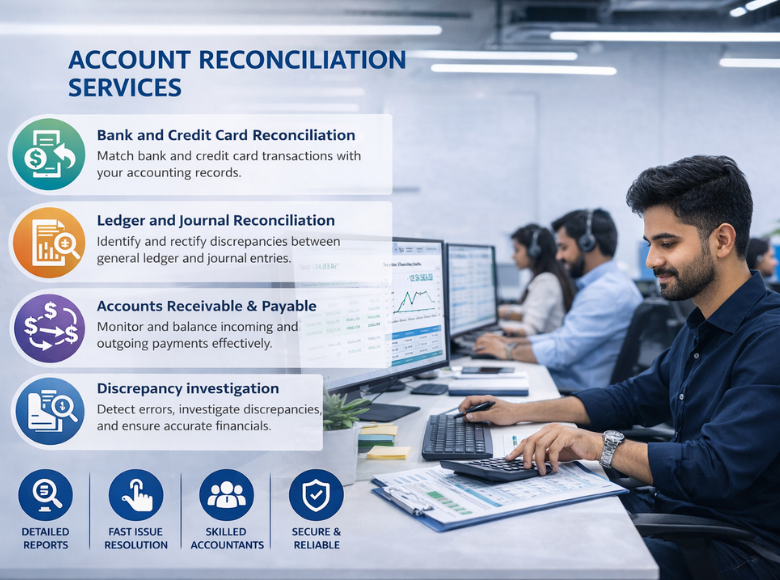
- Matching transactions between ledgers and bank statements
- Identifying discrepancies and resolving errors
- Validating financial data across systems
- Preparing accurate financial reports
Effective Account Reconciliation Services ensure that businesses maintain accurate financial records, reduce errors, and stay audit-ready.
Account Reconciliation Process Explained
A structured reconciliation process is essential for accuracy and efficiency.
1. Data Collection: Gather financial data from multiple sources such as bank statements, ERP systems, and internal records.
2. Transaction Matching: Compare transactions across systems to identify matches and discrepancies.
3. Exception Identification: Highlight unmatched or incorrect entries for further review.
4. Resolution and Adjustment: Investigate discrepancies and make necessary corrections.
5. Reporting and Documentation: Prepare reconciliation reports and maintain audit trails.
Modern Account Reconciliation Services rely on structured workflows to ensure consistency and control.
Key Challenges in Account Reconciliation
Despite its importance, managing Account Reconciliation Services internally presents several challenges:
1. Manual Errors: Human errors in data entry and matching can lead to inaccuracies.
2. High Transaction Volumes: Large volumes of financial data make reconciliation time-consuming.
3. Delayed Financial Close: Inefficient processes slow down reporting and decision-making.
4. Lack of Standardization: Inconsistent workflows lead to errors and compliance risks.
In industries where documentation accuracy is critical, structured approaches, similar to those used in legal administration outsourcing services highlight the importance of consistency and control.
Role of Automation in Account Reconciliation
Automation is transforming how Account Reconciliation Services are delivered.
1. Improved Accuracy: Automated systems reduce human error in transaction matching.
2. Faster Processing: Large volumes of data can be processed quickly and efficiently.
3. Real-Time Insights: Businesses gain visibility into financial discrepancies instantly.
4. Enhanced Compliance: Automated audit trails ensure transparency and regulatory compliance.
Organizations that combine automation with account reconciliation outsourcing achieve higher efficiency and accuracy.
Best Practices for Efficient Account Reconciliation Services
To optimize Account Reconciliation Services, businesses should adopt:
- Standardized Workflows: Define clear processes for reconciliation to ensure consistency.
- Automation Integration: Use technology to reduce manual effort and improve accuracy.
- Regular Monitoring: Continuously track discrepancies and resolve issues promptly.
- Strong Documentation: Maintain audit trails for compliance and reporting.
- Cross-Functional Coordination: Ensure alignment between finance and related operations, similar to structured workflows in mortgage processing outsourcing services where accuracy and validation are critical.
How Dhaninfo Delivers High-Accuracy Account Reconciliation Services at Scale
Dhaninfo supports finance teams with a structured and process-driven approach to Account Reconciliation Services, ensuring accuracy, consistency, and strong financial control across high-volume operations. Our delivery model is designed to enhance efficiency, maintain compliance, and support faster financial close cycles
1. Requirement Assessment and Reconciliation Framework Design
We begin by analyzing transaction volumes, reconciliation complexity, reporting requirements, and compliance expectations. Based on this, we design a tailored reconciliation framework aligned with business processes and financial objectives.
2. Structured Workflow Setup and Standardization
Clear workflows and approval structures are established across reconciliation processes to ensure consistency, traceability, and operational control. Standardization reduces variability and improves overall efficiency.
3. Transaction Matching and Exception Handling
Transactions are systematically matched across systems, with discrepancies identified and managed through structured exception-handling processes. This ensures timely resolution without impacting reporting timelines.
4. Multi-Layer Quality Assurance and Financial Control
We implement multiple levels of validation and review to ensure reconciliation accuracy. Structured checkpoints and governance frameworks maintain consistency, compliance, and financial integrity.
5. Reporting and Financial Visibility
Detailed reporting and dashboards provide visibility into reconciliation status, discrepancies, and financial performance. This enables better monitoring and informed decision-making.
6. Scalable and Audit-Ready Delivery Model
Our delivery model is designed to scale with business growth, enabling organizations to manage increasing transaction volumes efficiently. Structured documentation and processes ensure continuous audit readiness.
FAQs
1.What are account reconciliation services?
Account reconciliation services ensure that financial records match across systems, helping businesses maintain accuracy and detect discrepancies.
2. Why are account reconciliation services important?
They help prevent errors, improve financial accuracy, and ensure compliance with reporting and audit requirements.
3.How often should reconciliation be done?
Reconciliation should be done regularly, daily, weekly, or monthly, based on transaction volume and business needs.
4. What are common reconciliation challenges?
Common issues include manual errors, high data volumes, delays, and a lack of standardized processes.
5. Can reconciliation improve financial reporting?
Yes, accurate reconciliation ensures reliable financial reports and better decision-making.
Conclusion
In an increasingly complex financial environment, Account Reconciliation Services are essential for maintaining accuracy, compliance, and efficiency.
By combining structured processes, automation, and account reconciliation outsourcing, businesses can reduce errors, improve reporting, and scale operations effectively.
With the right approach, reconciliation becomes not just a process but a strategic advantage for financial performance and growth.
Streamline Your Financial Accuracy with Expert Reconciliation Support
Managing reconciliation internally can lead to inefficiencies and errors.
Dhaninfo provides reliable Account Reconciliation Services and finance & accounting outsourcing services designed to improve accuracy, accelerate financial close cycles, and enhance operational efficiency.
Contact us today to optimize your reconciliation processes.